

By HOWARD FENDRICH, Related Press Tennis Author
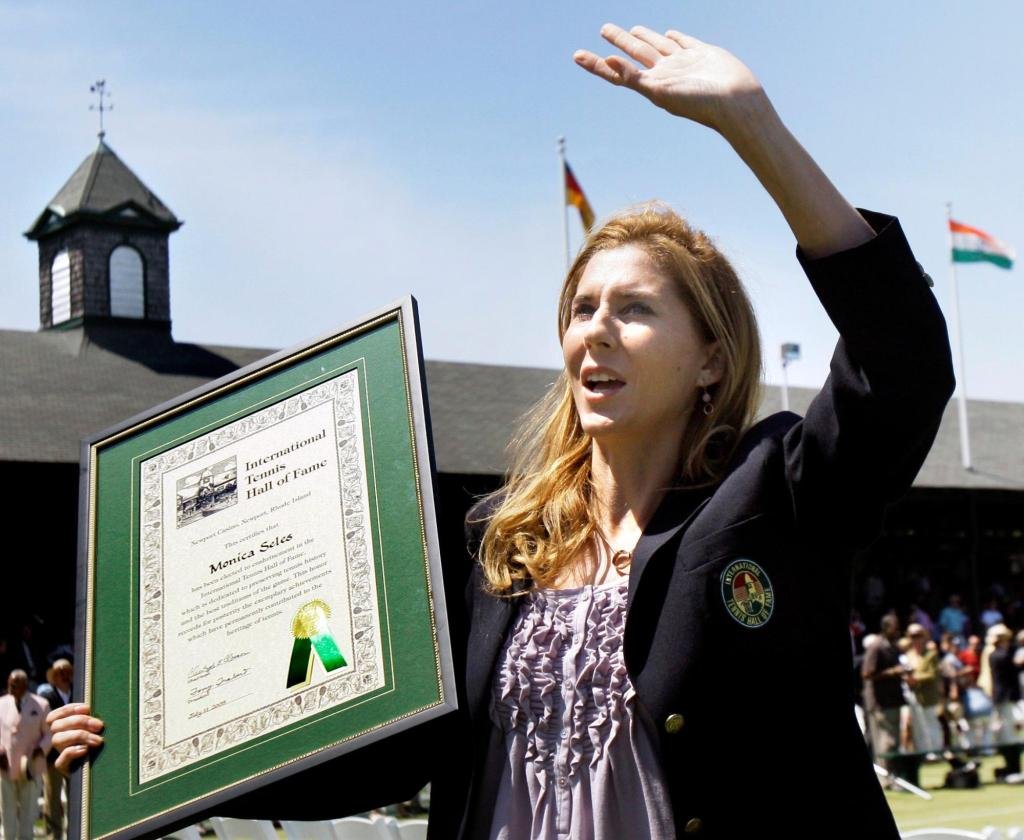
Monica Seles first seen the signs of myasthenia gravis — a neuromuscular autoimmune illness she mentioned throughout a latest interview with The Related Press — whereas she was swinging a racket the way in which she’d executed so many occasions throughout, and after, a profession that included 9 Grand Slam titles and a spot within the Worldwide Tennis Corridor of Fame.
“I might be taking part in with some youngsters or relations, and I might miss a ball. I used to be like, ‘Yeah, I see two balls.’ These are clearly signs which you can’t ignore,” Seles stated. “And, for me, that is when this journey began. And it took me fairly a while to essentially take in it, communicate overtly about it, as a result of it’s a troublesome one. It impacts my day-to-day life quite a bit.”
The 51-year-old Seles, who received her first main trophy at age 16 on the 1990 French Open and performed her final match in 2003, stated she was identified with myasthenia gravis three years in the past and is talking publicly about it for the primary time forward of the U.S. Open, which begins on Aug. 24, to lift consciousness about what is named MG.
The Nationwide Institute of Neurological Issues and Stroke calls it “a power neuromuscular illness that causes weak point within the voluntary muscle mass” and “mostly impacts younger grownup ladies (underneath 40) and older males (over 60) however … can happen at any age, together with childhood.”
Seles stated she’d by no means heard of the situation till seeing a physician and being referred to a neurologist after noticing signs resembling double imaginative and prescient and weak point in her arms — “simply blowing my hair out … turned very troublesome,” she stated — and legs.
“Once I obtained identified, I used to be like, ‘What?!’” stated Seles, who’s partnering with argenx, an immunology firm headquartered within the Netherlands, to advertise their Go for Greater marketing campaign. “So that is the place — I can’t emphasize sufficient — I want I had anyone like me communicate up about it.”
It’s been three a long time since Seles returned to competitors on the 1995 U.S. Open, making it to the ultimate, greater than two years after she was attacked by a person with a knife at a match in Hamburg, Germany.
“The way in which they welcomed me … after my stabbing, I’ll always remember,” Seles stated in regards to the followers in New York. “These are the moments that stick with you.”
She talks about studying to stay a “new regular” these days and characterised her well being as one other in a collection of life steps that required adapting.
“I needed to, in tennis phrases, I suppose, reset — onerous reset — a couple of occasions. I name my first onerous reset after I got here to the U.S. as a younger 13-year-old (from Yugoslavia). Didn’t communicate the language; left my household. It’s a really robust time. Then, clearly, changing into an awesome participant, it’s a reset, too, as a result of the celebrity, cash, the eye, adjustments (all the things), and it’s onerous as a 16-year-old to cope with all that. Then clearly my stabbing — I needed to do an enormous reset,” Seles stated.
“After which, actually, being identified with myasthenia gravis: one other reset. However one factor, as I inform youngsters that I mentor: ‘You’ve obtained to all the time modify. That ball is bouncing, and also you’ve simply obtained to regulate,’” she added. “And that’s what I’m doing now.”
Howard Fendrich has been the AP’s tennis author since 2002.
Initially Printed:
