

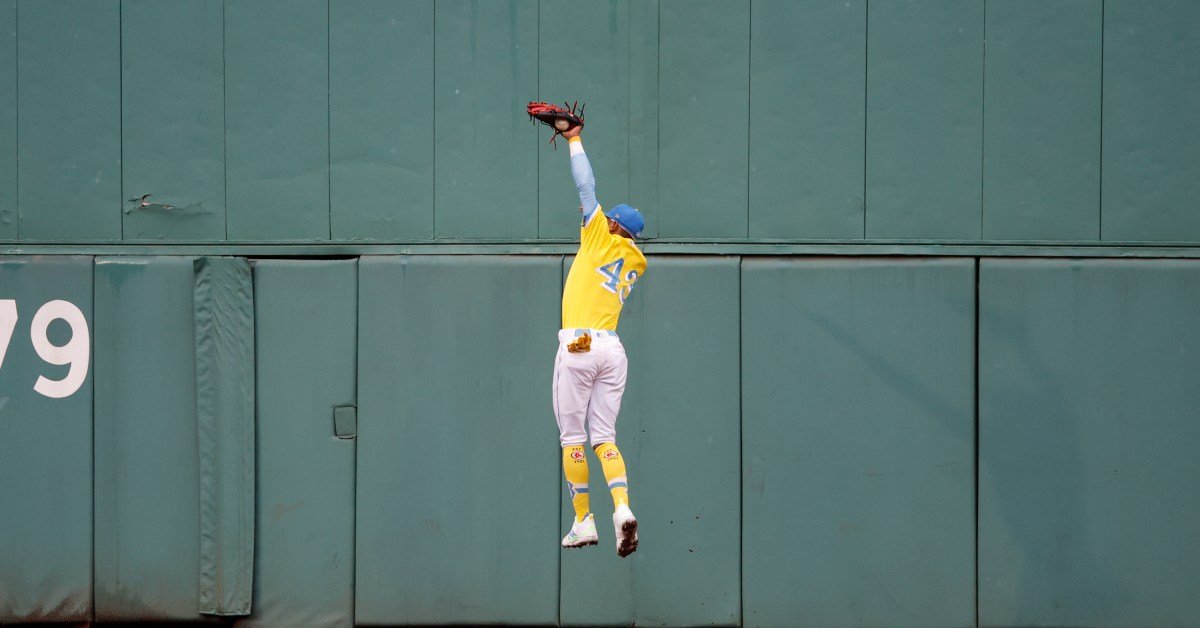
In 2025, the Boston Purple Sox led all of baseball in errors, a statistical class they’ve been close to the highest of for a number of years now.
And but, most defensive metrics don’t suppose the Sox are that dangerous, and a few suppose they’re elite. By Statcast’s Fielding Run Worth as introduced by Baseball Savant, the Purple Sox had the fifth-best defense in baseball final yr. By Statcast’s Fielding Run Worth as introduced by FanGraphs (which is outwardly a barely totally different factor, although I couldn’t let you know how) they had been the seventh-best. By Statcast’s Outs Above Common as introduced by FanGraphs, they were the tenth-best. By Statcast’s Outs Above Common as introduced by Savant (once more, by some means totally different!), they were more middling at number 13. And by Defensive Runs Saved from the Fielding Bible, they were twelfth.
Which of those metrics is the proper metric? Properly, in response to the principles of arguing about baseball on the web, the appropriate metric is the one which helps you show no matter level you’ve already determined you need to make. If you wish to say that the Sox suck defensively, go forward and use errors. If you wish to say they’re nice, go forward and use Fielding Run Worth. If you wish to present a nuanced opinion, select any of the others, however no person cares for nuance and everybody will ignore you.
The reality is that defensive metrics are far behind the metrics we use to measure pitching and hitting, and so they most likely all the time can be. That is simply how the sector of statistics works: some issues are more durable to measure than others.
Complicating the problem within the case of the Purple Sox is the truth that roster options gamers of shockingly disparate defensive high quality. Ceddanne Rafaela was arguably the perfect gloveman in all of baseball final yr; Kristian Campbell was arguably the worst. Carlos Narvaez graded out as elite by many metrics; Connor Wong graded out as horrendous. When Wilyer Abreu was wholesome, the Sox had the most effective defensive proper fielders you may ask for; when Rob Refsnyder was on the market, they had been under common. You get the image, and in case you don’t right here’s a reasonably stunning little picture:
In keeping with Savant’s OAA, the Purple Sox outfield (the desk on the left aspect of the slider) was far and away the perfect defensive outfield in baseball, with the hole between them and the quantity two group nearly twice as huge because the hole between quantity two and quantity three. However within the infield (on the appropriate of the slider) they had been the second-worst assortment of defenders, a whopping 47 runs worse than the league leaders.
We nonetheless don’t know what the Purple Sox infield will appear to be, however it most likely received’t have Kristian Campbell in it anymore. It would have Willson Contreras, who was the sixth-best first baseman in baseball by Savant’s OAA. Marcelo Mayer ought to completely be a plus-defender, although we don’t but know precisely how good he’ll be, how a lot he’ll play, or the place he’ll play. A lot of the identical will be stated about Isiah Kiner-Falefa. Trevor Story, David Hamilton, and Romy Gonzalez, although, are fairly dangerous by most metrics.
After which there’s the problem of the revamped pitching workers. The Purple Sox outfield (the strongest a part of their protection, keep in mind!) had 1074 complete fielding possibilities in 2025, which was truly fairly low general. And the outfield could get even fewer possibilities in 2026, because of the additions of Sonny Grey and Ranger Suárez, two pitchers who induce grounders at a a lot larger charge than most starters (identical to Garrett Crochet).
So how good will the Purple Sox protection be in 2026? Discuss that or no matter else you need, and, as all the time, be good to at least one one other.
