

By JENNIFER McDERMOTT and PAT GRAHAM
Davide Cerato will play a serious function in snowboarding and snowboarding occasions on the upcoming Olympics, however he gained’t be competing.
The Italian snowmaking professional is chargeable for perfecting a number of of the programs that may function within the 2026 Milan Cortina Winter Games, and he takes his job critically.
“It’s an important race of their life,” Cerato mentioned. “Our obligation is to present them the most effective, to ship the most effective programs the place they will carry out their finest after coaching so exhausting.”
Cerato oversees operations at venues the place new snowmaking programs had been put in, together with in Bormio for Alpine ski racing and ski mountaineering, and in Livigno for freestyle snowboarding and snowboarding occasions. He has been working with the Worldwide Ski and Snowboard Federation and the Worldwide Olympic Committee for the reason that 2014 Sochi Olympics.
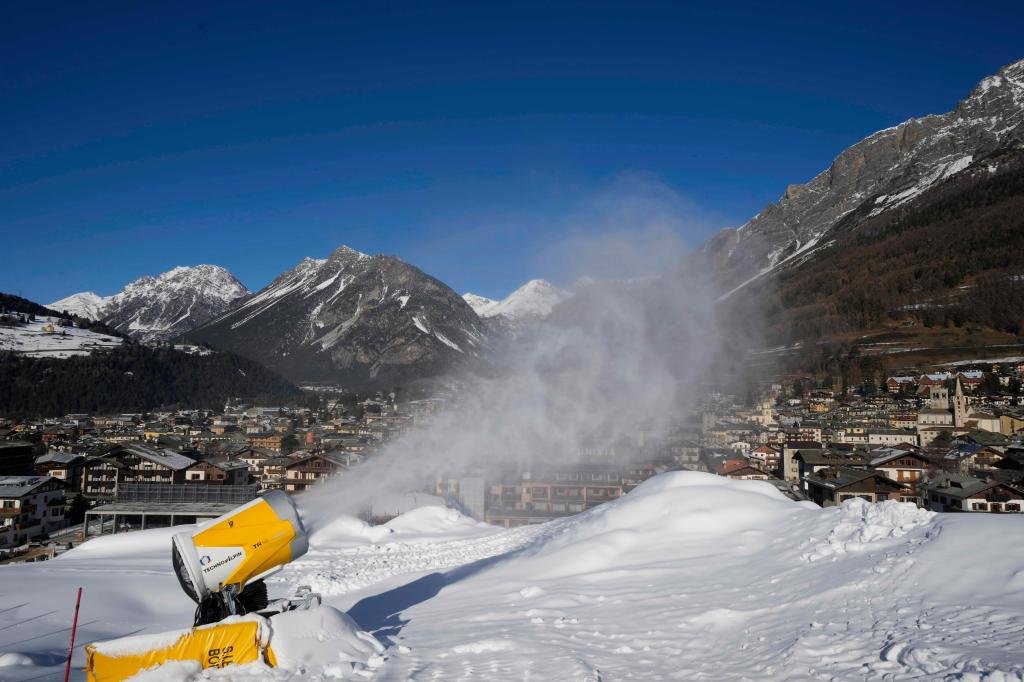
Lately, manufactured snow — “technical snow” as Cerato calls it — is a lifestyle in ski racing, a lot in order that Olympic athletes don’t assume twice about competing on it. Above all else, they need a course that may maintain up over a number of coaching runs and the races themselves with out changing into too mushy or rutted.
Mom Nature can’t all the time present for that, and with climate change affecting winter sports in particular, snowmaking has turn out to be important.
New reservoirs and snow weapons
The organizing committee estimates the Video games will want roughly 250 million gallons of water, the equal of almost 380 Olympic swimming swimming pools, for snowmaking. Cerato oversaw the work to carve out new high-elevation water reservoirs to retailer it.
On the Livigno Snow Park, they constructed a basin able to holding about 53 million gallons of water. It’s now one of many greatest reservoirs on the Italian facet of the Alps, Cerato mentioned. They added greater than 50 snow weapons there to supply about 211 million gallons of snow in roughly 300 hours.
In Bormio, Cerato mentioned they constructed a lake at an elevation of two,515 yards to carry 23 million gallons of water. Additionally they added 75 snow weapons for Alpine snowboarding and ski mountaineering.
“We introduced the Bormio slope to a brand new stage,” he mentioned, evaluating it to a “Ferrari with new gears.”
Making certain truthful, protected programs
By making snow, organizers can management a slope’s high quality and hardness, getting ready it based on FIS necessities and guaranteeing constant circumstances, Cerato mentioned.
He mentioned it’s simpler to work with technical snow as a result of it’s compact and is safer as a result of it doesn’t deteriorate as rapidly, whereas pure snow requires extra work. They’ll inject water deep into the snowpack, which can freeze and create a extra secure race floor.
“We will ship higher, safer and truthful programs,” he mentioned. “That’s the distinction — a good course from bib No. 1 to bib No. 50.”

Utilizing snowmaking sensor expertise
Cerato and his crew are utilizing state-of-the-art sensors to observe the snow depth. If there’s a niche, snow weapons go to work. If there’s an excessive amount of, they’re turned off.
“It robotically adjusts every thing, every snow gun, so you’ll be able to management with only one individual sitting within the workplace, all of the mountain,” Cerato mentioned.
In Bormio, snow groomers are additionally geared up with GPS programs to assist monitor the snow high quality and ranges, saving time, vitality and water.
The snow groomer is aware of precisely the place to push the snow and the way a lot snow is required. And on the identical time, “you produce the minimal quantity of snow that you just want,” Cerato mentioned. “This can be a highly effective instrument.”
Getting ready a slope for elite competitors isn’t the identical as doing it for industrial use. For the latter, pure snow is treasured, he mentioned. Personally, he prefers snowboarding in powder.
“I used to be born on the mountain,” he mentioned. “I really like snow.”
The Related Press’ local weather and environmental protection receives monetary help from a number of non-public foundations. AP is solely chargeable for all content material. Discover AP’s standards for working with philanthropies, an inventory of supporters and funded protection areas at AP.org.
